

Protecting Properties: Inside FloLogic’s Mission to Prevent Water Damage
By Andrew Morrissey
How a Raleigh-based leak detection innovator is revolutionizing plumbing protection with technology that can sense a half-ounce of water flow per minute
In an industrial park in Raleigh, North Carolina, where FloLogic was founded in 1997, a team of 18 employees is working to solve what has become one of the largest preventable loss categories in the property casualty insurance industry — water damage.
The average water damage claim now costs thousands to more than $100,000. For insurance carriers, at least a quarter of all losses paid out each year stem from water-related incidents. That’s why companies like FloLogic — recently acquired by Bradford White in 2024 — are experiencing solid growth, with annual increases in the 35% range.
“Insurance carriers recognize that water damage is preventable with proven leak detection technology solutions,” said Ian Greene, FloLogic’s marketing director, during a tour of the company’s headquarters.
FloLogic Follows Different Approach to Leak Detection
FloLogic’s approach to leak detection fundamentally differs from competitors who entered the market in the late 2010s. While other companies launched products focused on “water insights” — telling homeowners how many toilet flushes or showers they used daily — FloLogic remained focused on something more critical: detecting the smallest possible leaks.
“The competitive products were primarily built around a series of compromises to hit what they perceived to be the sweet spot for price,” Greene said. Those compromises matter more than most homeowners realize.
The physics of flow sensing means a device calibrated to measure high-volume usage — like multiple showers running simultaneously at 15-20 gallons per minute —can only detect low flows down to about one-hundredth of that maximum, so a sensor maxed out at 10 gallons per minute can’t reliably detect anything below one-tenth of a gallon per minute.
FloLogic’s original product could detect flow rates around 8 ounces per minute. The current system can measure a half ounce per minute in real time — essentially a couple drips per second.
“That’s when water really starts moving at any pace through the system,” Greene said. “Because theoretically, plumbing should be a sealed system. Nothing should be moving. If water is moving, it’s because it’s escaping somewhere downstream.”
Whether it’s a drippy faucet, a cracked pipe thawing from a frozen ice plug, or a water heater starting to fail, FloLogic’s system quickly detects it.
Durability Over Disposability
The other major differentiator is longevity. While competitors designed products to hit lower price points — $500 to $800 retail — FloLogic built theirs to last.
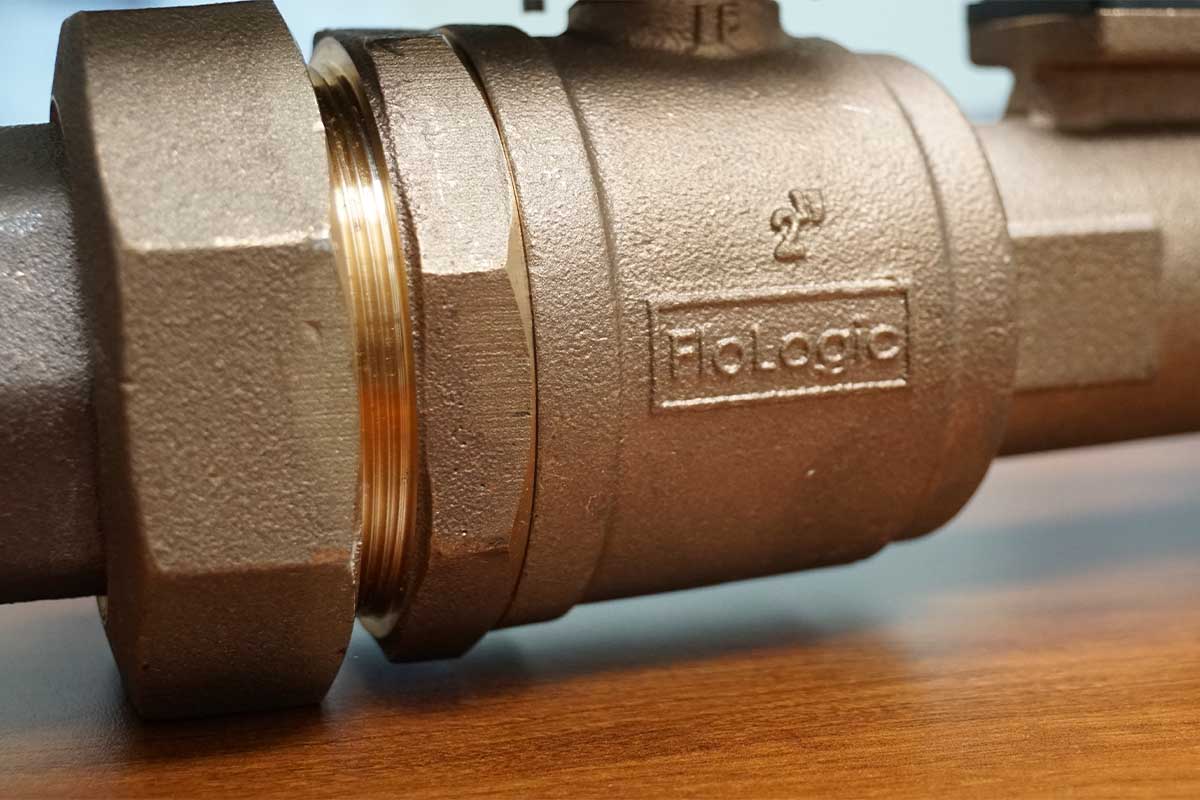
“This will be a product that’s going to last you 20 years in your house,” Ian said, showing one of the valve assemblies. “Those may last you five years.”
The valve itself is cast in Pennsylvania and machined in North Carolina. It is designed for field servicing with replaceable components like the flow sensor and backup battery. It’s rated IP 67, meaning it can handle outdoor installations in valve boxes, which is important for properties in the Sunbelt and Deep South where plumbing often enters through concrete slabs.
The price difference between FloLogic and budget competitors is about $1,000 all-in, including installation, but spread over 20 years instead of five, the value proposition grows, especially for high-end residential properties that sit empty for extended periods and face the largest losses when leaks occur.


Lean Manufacturing Model
Despite its growth, FloLogic has maintained a lean operational structure. The Raleigh facility houses everything except manufacturing: design, engineering, customer support, parts depot, executive management, finance, operations, and marketing.
The company recently acquired an additional 6,500 square feet across the parking lot to more than double its available space to accommodate new hires across multiple departments.
“As your population in the field gets greater, you need more support folks to answer phone calls,” Greene said.
Customer support is central to FloLogic’s business model, extending all the way to end consumers. When a plumber installs its product, FloLogic provides assurance the company will handle any customer support needs directly.
“The plumber doesn’t have to deal with callbacks or things they may not be intimately familiar with,” Greene said.
For manufacturing, FloLogic contracts with approximately six primary suppliers, keeping the organization lean while maintaining quality. The valve body is domestic. Actuators come from Titusville, Florida. Power supplies are sourced from Asia. It’s a deliberately diversified supply chain that has largely insulated them from tariff impacts, though their expanding line of connected devices has necessitated some global sourcing.
Simple Installation
For plumbers, FloLogic’s system is straightforward to install. The valve features universal union fittings on both sides — slide it in, tighten the connections, power it up. It can be installed in any orientation and requires a standard electrical outlet and comes standard with a backup battery.
The system arrives with preset default settings that work for most properties. Plumbers can fully test the system using local controls on the Connect Module without ever putting it online, leaving that step to homeowners if they prefer. For plumbers who want to complete the full installation, connecting to the cloud is equally simple — just plug the gateway into the router, scan a barcode and the system finds itself.
While they offer legacy controls that do not connect to an app, today’s customer largely wants IoT connectivity.
A Complete System
The Connect Module provides local control with visible status indicators and physical buttons, crucial for situations where someone without app access needs to interact with the system.
The system has evolved from WiFi to Thread protocol for wireless connectivity — a mesh network standard being adopted across the smart home industry that’s more stable and easier to connect than traditional WiFi.
Pinpoint sensors extend protection beyond the main water line, physically detecting water accumulation anywhere in a property. The wireless sensors also monitor temperature and humidity, providing alerts for conditions that could lead to damage even from non-plumbing sources like condensate pans or external water intrusion. They can trigger automatic shutoffs when they detect water or simply notify homeowners.
For properties with irrigation systems, water softeners, hot water recirculating pumps, or security systems, the Remote I/O (input / output) module provides interfaces that allow protection settings while accommodating devices that need to run water for extended periods. It can tell a recirculating pump to shut off if the main valve closes, preventing burnout, or stop it from running when the property is in “away” mode for energy efficiency.
“That’s what FloLogic is designed to do,” Greene said. “Ultimately, we’re a water control device, a plumbing system control device.”
Market Growth and Expansion
FloLogic’s core market is high-end residential properties, but the Bradford White acquisition in 2024 opened new doors.
“They’ve got a commercial sales focus that we’ve never had before,” said Douglass Phillips, FloLogic’s general manager. Bradford White’s network of representatives creates opportunities in commercial spaces where water is essential to business operations ranging from dental offices, bank branches and restaurants.
In commercial insurance, water loss is also among the single largest loss categories. The challenge is finding property owners willing to invest in prevention rather than building managers or tenants who won’t benefit from the long-term protection.
“Insurance is our biggest promoter,” Phillips said, “because they see this as accruing benefits to them.” FloLogic is working with commercial insurers to demonstrate how leak detection technology can reduce losses in that sector.
The Bigger Picture
What started as a curiosity about “water insights” — toilet flushes and shower duration — has evolved into an industry focused on loss prevention. While competitors initially tried to make water usage monitoring the selling point, the market has evolved into an insurance-driven model to reduce risk and damage.
Smart systems are commonplace now — with many homeowners already using smart thermostats, security cameras, and connected devices — protecting the plumbing system becomes appealing. The same consumers who wouldn’t think twice about monitoring their home security or controlling their HVAC remotely are increasingly interested in protecting their water supply.
“Water’s so cheap,” Phillips said. “It’s a curiosity when you first get it (a flow monitor), but once you’ve looked at your water use for two or three months, it kind of gets boring. But insurance companies have continued to beat the drumbeat of water loss prevention.”



Other Recent Features
Skilled Trades Enrollment GrowingArticles | April 16, 2026 |
Turn Uncertainty into OpportunityArticles | April 16, 2026 |
Oatey Co. Promotes Two Executives| April 13, 2026 |
PHCC’s New President Charts Course for 2026Industry News | April 13, 2026 |
Keeping Score Will Make a DifferenceArticles | April 13, 2026 |